Is Hydrogen Water in Plastic Bottles Worth It? 5 Key Facts
If you've been browsing hydrogen water options this November 2026, you've probably noticed something: it comes in all kinds of packaging. Plastic bottles, pouches, aluminum cans, even machines that make it at home. And one question keeps coming up from readers deciding where to spend their money: is hydrogen water in plastic bottles worth it? It's a fair question, because on the shelf, a plastic bottle of hydrogen water can look just like any other premium water. The difference isn't visible to the eye — it's happening at the molecular level, and it has everything to do with whether you're actually getting the hydrogen you're paying for. Here are five facts to consider before you buy, counting down from the most important.
1. HYDROGEN IS THE SMALLEST MOLECULE IN THE UNIVERSE, AND PLASTIC CAN'T HOLD IT
This is the single most important thing to understand. Molecular hydrogen (H2) is the smallest molecule that exists, which makes it remarkably good at slipping through materials that would easily contain ordinary liquids or even carbonation. Plastic, at a microscopic level, is porous enough that hydrogen gas can pass right through the bottle walls. The water stays put, but the hydrogen quietly escapes — often within days of bottling. That means a plastic bottle of hydrogen water that was infused at a respectable concentration at the factory may have lost much of its dissolved hydrogen by the time it reaches a warehouse, then a store shelf, then your refrigerator. You're left paying a premium price for what is, functionally, regular water. If you want a deeper look at how packaging affects what actually ends up in your glass, our breakdown of plastic vs aluminum hydrogen water packaging and cost walks through it in detail.
2. ALUMINUM IS IMPERMEABLE TO HYDROGEN, WHICH IS WHY SERIOUS BRANDS USE CANS
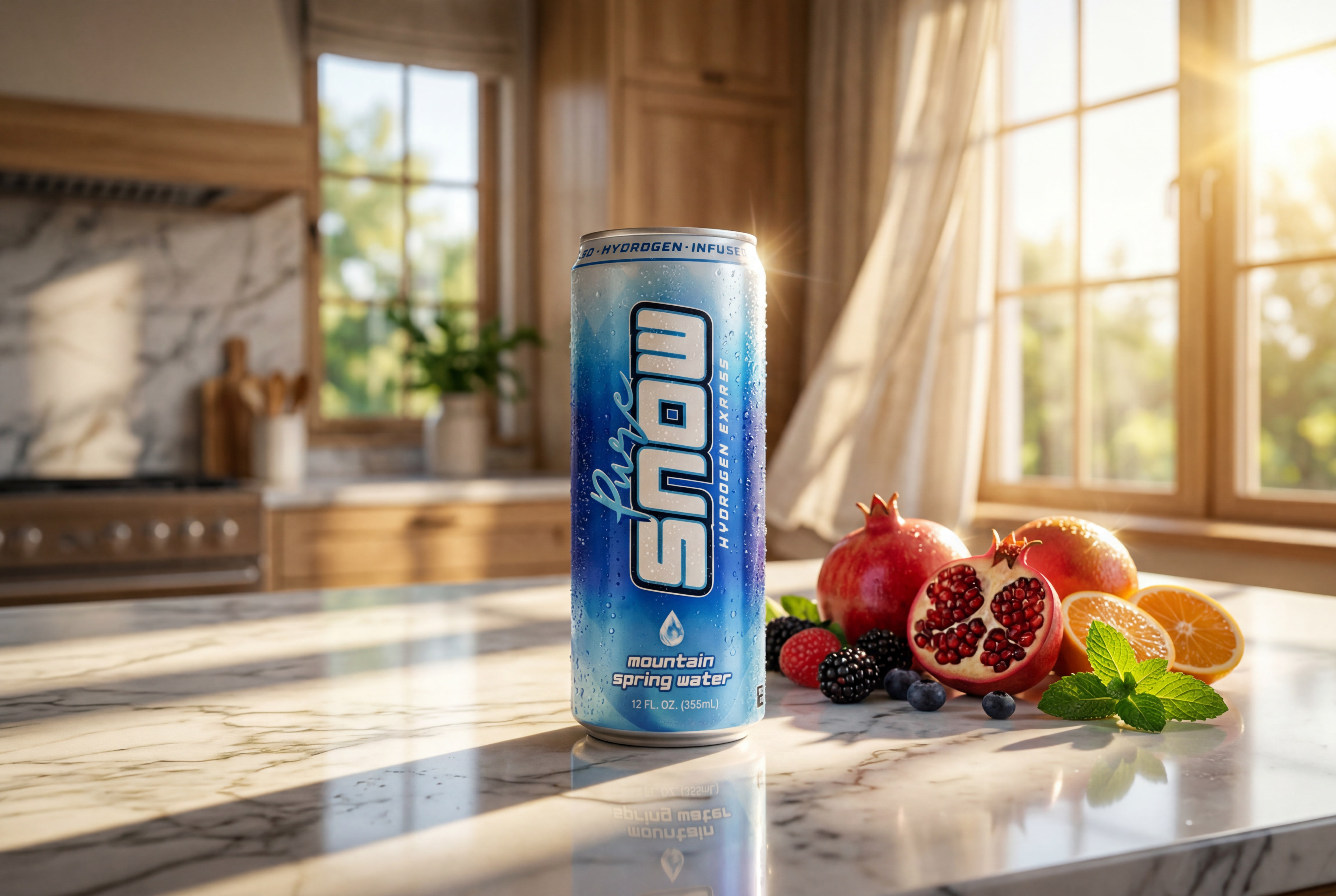
Aluminum solves the problem plastic can't. Because aluminum is impermeable to hydrogen, a properly sealed can locks the gas in with the water, where it stays dissolved for months rather than days. This is exactly why Pure Snow is packaged in 12 oz hermetically sealed aluminum cans — the hermetic seal plus the aluminum barrier means the 2-3 PPM of molecular hydrogen we infuse at canning is still there when you pop the tab, whether that's next week or several months from now. The one thing to remember with any canned hydrogen water: once you open it, the clock starts. Hydrogen begins escaping as soon as the water is exposed to air, so you'll want to finish a can within 10-15 minutes for maximum potency. You can read more about the science behind the seal, the PPM, and our spring source on our how it works page.
3. PPM ONLY MATTERS IF IT'S STILL THERE WHEN YOU DRINK IT
PPM — parts per million — is how dissolved hydrogen concentration is measured, and it's the number that tells you how much hydrogen you're actually getting. Here's the catch with plastic: a label can honestly state the PPM at the time of bottling, but that number says nothing about what's left after the hydrogen has had days or weeks to escape through the packaging. A high PPM on a plastic bottle is a snapshot of the past, not a promise about the present. With an impermeable aluminum can, the PPM printed on the label and the PPM in your glass stay aligned for months. Pure Snow is formulated at 2-3 PPM, and the sealed can is what makes that number meaningful. When you're comparing products, don't just compare the PPM claims — compare whether the packaging can actually preserve them.
4. THE RESEARCH IS ON HYDROGEN, NOT ON THE BOTTLE
It's worth remembering why people drink hydrogen water in the first place. According to research indexed in the National Library of Medicine, over 1,000 peer-reviewed studies have explored molecular hydrogen, in areas including exercise recovery, oxidative stress, inflammation response, cognitive function, sleep quality, energy, and gut health. We want to be careful and honest here: this research is ongoing and exploratory, and hydrogen water isn't a treatment or cure for anything. But the key point for packaging is simple — everything researchers are studying depends on the molecular hydrogen being present in the water you drink. If the hydrogen has escaped through plastic before the bottle reaches you, the entire reason for choosing hydrogen water over regular water disappears with it. The packaging isn't a side detail; it's the whole ballgame.
5. VALUE ISN'T JUST PRICE PER BOTTLE — IT'S PRICE PER PPM DELIVERED
Plastic-bottled hydrogen water sometimes looks cheaper on the shelf, and that's where many buyers get drawn in. But the real question is what you're getting for the money. Paying less for water that has quietly lost its hydrogen isn't a bargain — it's just expensive water. For context, hydrogen water machines run $400-$2,000 upfront plus maintenance, and portable hydrogen bottles typically cost $90-$250 and produce inconsistent PPM. Canned hydrogen water sits in a practical middle ground: no equipment, no maintenance, and reliable potency in every can. A one-time 12-pack of Pure Snow is $29.99 — about $2.50 per can — and subscribers pay $17.99 for their first 12-pack (40% off), then $24.99 per case (20% off) after that, with free shipping on every order, locked-in pricing, and the freedom to skip, pause, swap, or cancel anytime with no fees. You can see the full breakdown on our pricing page. When you calculate cost against hydrogen actually delivered, the sealed aluminum can is hard to beat.
SO, IS PLASTIC-BOTTLED HYDROGEN WATER EVER WORTH IT?
Honestly, in most cases, no — and it's not because of the brands behind it, but because of physics. Plastic simply cannot contain the smallest molecule in existence for any meaningful length of time. If a plastic-bottled hydrogen water is consumed within days of production, some hydrogen may remain, but as a shopper you rarely know how long a bottle has been in transit or on a shelf. Aluminum removes that uncertainty entirely. And the water inside the can matters too: Pure Snow starts with Ouachita Mountain spring water from Arkansas, a source that has earned 19 honors from the Berkeley Springs International Water Tasting competition, including multiple Best Tasting Water in the World titles. Great base water, real hydrogen, and packaging that protects both — that's what worth it actually looks like.
KEY TAKEAWAY: Hydrogen water in plastic bottles is rarely worth it because hydrogen, the smallest molecule in the universe, escapes through plastic within days — while hermetically sealed aluminum cans keep it locked in for months, so you actually get what you pay for.
If you're ready to taste the difference a sealed can makes, try Pure Snow today and experience award-winning Ouachita Mountain spring water infused at 2-3 PPM. Every first case is backed by our 30-day taste guarantee — if you don't love it, we'll refund it, no questions asked.
FAQ
Q: How long does hydrogen stay in a plastic bottle of hydrogen water?
A: Because hydrogen is the smallest molecule in existence, it can pass through plastic bottle walls, often escaping within days of bottling. That means much of the hydrogen may be gone before the bottle ever reaches you. Aluminum cans, by contrast, are impermeable to hydrogen and keep it sealed in for months.
Q: Why does Pure Snow use aluminum cans instead of plastic bottles?
A: Aluminum is impermeable to hydrogen, so a hermetically sealed can preserves the 2-3 PPM of molecular hydrogen for months until you open it. Plastic simply can't provide that barrier, no matter how well the water was infused at the factory.
Q: How quickly should I drink hydrogen water after opening the can?
A: Once a can is opened and the water is exposed to air, hydrogen begins to escape. For maximum potency, finish your can within 10-15 minutes of opening — a 12 oz serving makes that easy to do.
Back to Blog1. HYDROGEN IS THE SMALLEST MOLECULE IN THE UNIVERSE, AND PLASTIC CAN'T HOLD IT
This is the single most important thing to understand. Molecular hydrogen (H2) is the smallest molecule that exists, which makes it remarkably good at slipping through materials that would easily contain ordinary liquids or even carbonation. Plastic, at a microscopic level, is porous enough that hydrogen gas can pass right through the bottle walls. The water stays put, but the hydrogen quietly escapes — often within days of bottling. That means a plastic bottle of hydrogen water that was infused at a respectable concentration at the factory may have lost much of its dissolved hydrogen by the time it reaches a warehouse, then a store shelf, then your refrigerator. You're left paying a premium price for what is, functionally, regular water. If you want a deeper look at how packaging affects what actually ends up in your glass, our breakdown of plastic vs aluminum hydrogen water packaging and cost walks through it in detail.
2. ALUMINUM IS IMPERMEABLE TO HYDROGEN, WHICH IS WHY SERIOUS BRANDS USE CANS
Aluminum solves the problem plastic can't. Because aluminum is impermeable to hydrogen, a properly sealed can locks the gas in with the water, where it stays dissolved for months rather than days. This is exactly why Pure Snow is packaged in 12 oz hermetically sealed aluminum cans — the hermetic seal plus the aluminum barrier means the 2-3 PPM of molecular hydrogen we infuse at canning is still there when you pop the tab, whether that's next week or several months from now. The one thing to remember with any canned hydrogen water: once you open it, the clock starts. Hydrogen begins escaping as soon as the water is exposed to air, so you'll want to finish a can within 10-15 minutes for maximum potency. You can read more about the science behind the seal, the PPM, and our spring source on our how it works page.
3. PPM ONLY MATTERS IF IT'S STILL THERE WHEN YOU DRINK IT
PPM — parts per million — is how dissolved hydrogen concentration is measured, and it's the number that tells you how much hydrogen you're actually getting. Here's the catch with plastic: a label can honestly state the PPM at the time of bottling, but that number says nothing about what's left after the hydrogen has had days or weeks to escape through the packaging. A high PPM on a plastic bottle is a snapshot of the past, not a promise about the present. With an impermeable aluminum can, the PPM printed on the label and the PPM in your glass stay aligned for months. Pure Snow is formulated at 2-3 PPM, and the sealed can is what makes that number meaningful. When you're comparing products, don't just compare the PPM claims — compare whether the packaging can actually preserve them.
4. THE RESEARCH IS ON HYDROGEN, NOT ON THE BOTTLE
It's worth remembering why people drink hydrogen water in the first place. According to research indexed in the National Library of Medicine, over 1,000 peer-reviewed studies have explored molecular hydrogen, in areas including exercise recovery, oxidative stress, inflammation response, cognitive function, sleep quality, energy, and gut health. We want to be careful and honest here: this research is ongoing and exploratory, and hydrogen water isn't a treatment or cure for anything. But the key point for packaging is simple — everything researchers are studying depends on the molecular hydrogen being present in the water you drink. If the hydrogen has escaped through plastic before the bottle reaches you, the entire reason for choosing hydrogen water over regular water disappears with it. The packaging isn't a side detail; it's the whole ballgame.
5. VALUE ISN'T JUST PRICE PER BOTTLE — IT'S PRICE PER PPM DELIVERED
Plastic-bottled hydrogen water sometimes looks cheaper on the shelf, and that's where many buyers get drawn in. But the real question is what you're getting for the money. Paying less for water that has quietly lost its hydrogen isn't a bargain — it's just expensive water. For context, hydrogen water machines run $400-$2,000 upfront plus maintenance, and portable hydrogen bottles typically cost $90-$250 and produce inconsistent PPM. Canned hydrogen water sits in a practical middle ground: no equipment, no maintenance, and reliable potency in every can. A one-time 12-pack of Pure Snow is $29.99 — about $2.50 per can — and subscribers pay $17.99 for their first 12-pack (40% off), then $24.99 per case (20% off) after that, with free shipping on every order, locked-in pricing, and the freedom to skip, pause, swap, or cancel anytime with no fees. You can see the full breakdown on our pricing page. When you calculate cost against hydrogen actually delivered, the sealed aluminum can is hard to beat.
SO, IS PLASTIC-BOTTLED HYDROGEN WATER EVER WORTH IT?
Honestly, in most cases, no — and it's not because of the brands behind it, but because of physics. Plastic simply cannot contain the smallest molecule in existence for any meaningful length of time. If a plastic-bottled hydrogen water is consumed within days of production, some hydrogen may remain, but as a shopper you rarely know how long a bottle has been in transit or on a shelf. Aluminum removes that uncertainty entirely. And the water inside the can matters too: Pure Snow starts with Ouachita Mountain spring water from Arkansas, a source that has earned 19 honors from the Berkeley Springs International Water Tasting competition, including multiple Best Tasting Water in the World titles. Great base water, real hydrogen, and packaging that protects both — that's what worth it actually looks like.
KEY TAKEAWAY: Hydrogen water in plastic bottles is rarely worth it because hydrogen, the smallest molecule in the universe, escapes through plastic within days — while hermetically sealed aluminum cans keep it locked in for months, so you actually get what you pay for.
If you're ready to taste the difference a sealed can makes, try Pure Snow today and experience award-winning Ouachita Mountain spring water infused at 2-3 PPM. Every first case is backed by our 30-day taste guarantee — if you don't love it, we'll refund it, no questions asked.
FAQ
Q: How long does hydrogen stay in a plastic bottle of hydrogen water?
A: Because hydrogen is the smallest molecule in existence, it can pass through plastic bottle walls, often escaping within days of bottling. That means much of the hydrogen may be gone before the bottle ever reaches you. Aluminum cans, by contrast, are impermeable to hydrogen and keep it sealed in for months.
Q: Why does Pure Snow use aluminum cans instead of plastic bottles?
A: Aluminum is impermeable to hydrogen, so a hermetically sealed can preserves the 2-3 PPM of molecular hydrogen for months until you open it. Plastic simply can't provide that barrier, no matter how well the water was infused at the factory.
Q: How quickly should I drink hydrogen water after opening the can?
A: Once a can is opened and the water is exposed to air, hydrogen begins to escape. For maximum potency, finish your can within 10-15 minutes of opening — a 12 oz serving makes that easy to do.