Hydrogen Water Machine vs Canned Cost Over a Year: Real Math
If you have been researching hydrogen water this October 2026, you have probably hit the same crossroads most curious drinkers reach: should you invest in a hydrogen water machine, or simply buy ready-to-drink cans? At first glance, the machine looks like the obvious long-term winner, since you pay once and make your own hydrogen water at home. But when you run the real numbers over a full year, and factor in the costs most comparisons conveniently skip, the picture gets a lot more interesting. As the team behind Pure Snow, we obviously have a horse in this race, so we will keep the math transparent and let you decide what fits your life and budget.
THE UPFRONT COST GAP
Let us start with the sticker prices, because this is where machines make their strongest first impression and their biggest demand. Hydrogen water machines typically cost between $400 and $2,000 upfront. That is a meaningful chunk of money to hand over before you have tasted a single sip, and before you know whether hydrogen water will actually become part of your routine. Canned hydrogen water flips that risk completely. A one-time 12-pack of Pure Snow costs $29.99, which works out to about $2.50 per can. With a subscription, the first 12-pack drops to $17.99, which is 40% off, and every order after that is $24.99 per 12-pack, roughly $2.08 per can, with free shipping on all orders. You can try hydrogen water for less than the cost of a dinner out, rather than committing the price of a new laptop to a countertop appliance.
WHAT A YEAR OF CANNED HYDROGEN WATER ACTUALLY COSTS
Here is where honest math matters, so let us run a few realistic scenarios using the subscription pricing on our pricing page. If you drink three to four cans a week, you will go through roughly fifteen 12-packs in a year. That is $17.99 for the first case plus fourteen cases at $24.99, or about $368 for the entire year. Even the cheapest machines cost more than that upfront. If you drink about six cans a week, you will use around twenty-six 12-packs, which comes to roughly $643 for the year. And if you drink a full can every single day, you are looking at about thirty 12-packs, or roughly $743 for the year. In that heavy-use scenario, a mid-range machine starts to look competitive on paper. But paper is exactly where the machine comparison tends to fall apart, because the upfront price is not the whole story.
THE HIDDEN COSTS MACHINES DO NOT ADVERTISE
Machines need maintenance. That is not a knock on any particular brand; it is simply the nature of a device that runs water through electrodes day after day. Ongoing upkeep adds cost and hassle that rarely shows up in the glossy comparison charts. There is also the question of what happens if the machine breaks, underperforms, or simply ends up gathering dust on the counter after a few months of enthusiasm. A $1,500 machine that gets abandoned in March is the most expensive hydrogen water you will ever not drink. Cans carry none of that risk. A subscription locks in your pricing, and you can skip, pause, swap, or cancel anytime with no fees. If your routine changes, your costs change with it instantly. And because every first case is backed by a 30-day taste guarantee that refunds your money with no questions asked, your actual financial risk of trying canned hydrogen water is effectively zero.
CONSISTENCY, POTENCY, AND WHAT YOU ARE ACTUALLY PAYING FOR
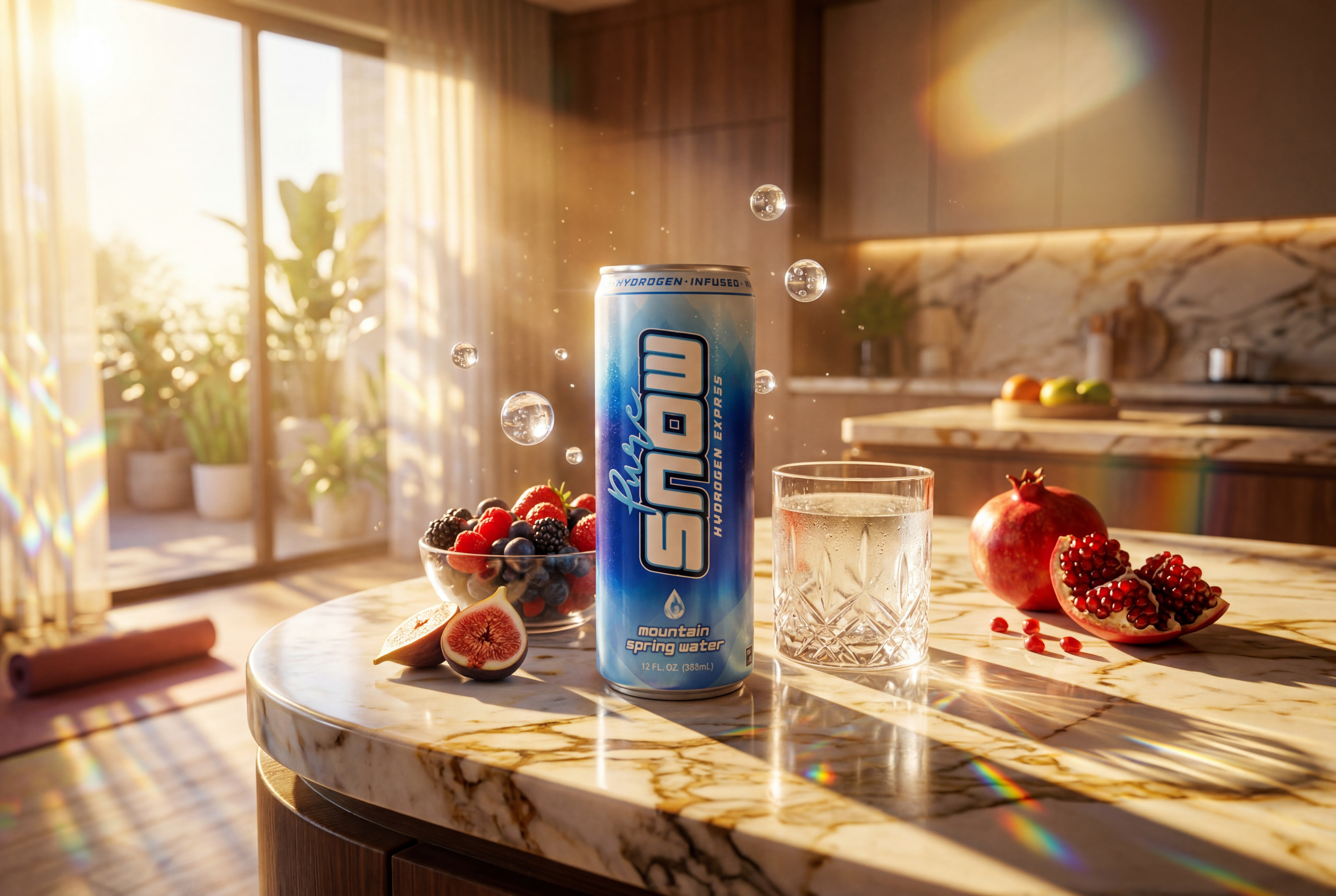
Cost per year only matters if you are comparing equivalent products, and this is where the differences get technical. Pure Snow is formulated at 2 to 3 PPM of molecular hydrogen and hermetically sealed in 12 oz aluminum cans. Aluminum is impermeable to hydrogen, which means the hydrogen stays locked inside a sealed can for months. Once you open a can, you simply finish it within 10 to 15 minutes for maximum potency, since hydrogen begins to escape once exposed to air. Compare that to the broader at-home landscape: hydrogen water bottles, the portable cousins of machines, typically run $90 to $250 and produce inconsistent PPM, and plastic bottles and pouches let hydrogen escape within days. When you pay roughly $2 per can, you are paying for a known, reliable concentration every single time, built on a base of Ouachita Mountain spring water from Arkansas, a source that has earned 19 honors from the Berkeley Springs International Water Tasting competition, including multiple Best Tasting Water in the World titles. You can read more about the concentration, the cans, and the source on our how it works page. It is also worth remembering why consistency matters at all: according to research indexed in the National Library of Medicine, over 1,000 peer-reviewed studies have explored molecular hydrogen in areas like exercise recovery, oxidative stress, inflammation response, cognitive function, sleep quality, energy, and gut health. That research is ongoing and nothing is proven, but the molecule being studied is dissolved hydrogen at meaningful concentrations, which is exactly what you want delivered reliably in every serving.
WHICH OPTION FITS YOUR LIFE
Here is our honest take. If you are a very heavy daily drinker, extremely diligent about maintenance, and certain hydrogen water will be part of your life for years, a machine can eventually pencil out. For almost everyone else, cans win the yearly math. Light and moderate drinkers spend far less per year with cans than the cheapest machine costs upfront. Even daily drinkers end up in similar territory once machine maintenance enters the equation, and cans add portability, zero upkeep, a guaranteed 2 to 3 PPM in every sealed can, and award-winning spring water as the base. If you want a deeper side-by-side, we broke the machine question down further in our machine cost vs canned water comparison.
KEY TAKEAWAY: Over a full year, canned hydrogen water costs less than a machine for most drinkers, roughly $368 to $743 depending on how much you drink, with no upfront investment, no maintenance, and a consistent 2 to 3 PPM in every hermetically sealed can.
If the math makes sense for your routine, the easiest next step is to try a case and taste the difference for yourself. Head to the Pure Snow shop to start with 40% off your first subscription case, fully covered by our 30-day taste guarantee.
FAQ
Q: Is a hydrogen water machine ever cheaper than cans over a year?
A: It can be, but mainly for very heavy drinkers who keep up with maintenance for multiple years. Machines cost $400 to $2,000 upfront plus ongoing upkeep, while a can-a-day subscription runs roughly $743 per year with zero maintenance and no upfront risk.
Q: How much does canned hydrogen water cost per can?
A: A one-time P
Back to BlogTHE UPFRONT COST GAP
Let us start with the sticker prices, because this is where machines make their strongest first impression and their biggest demand. Hydrogen water machines typically cost between $400 and $2,000 upfront. That is a meaningful chunk of money to hand over before you have tasted a single sip, and before you know whether hydrogen water will actually become part of your routine. Canned hydrogen water flips that risk completely. A one-time 12-pack of Pure Snow costs $29.99, which works out to about $2.50 per can. With a subscription, the first 12-pack drops to $17.99, which is 40% off, and every order after that is $24.99 per 12-pack, roughly $2.08 per can, with free shipping on all orders. You can try hydrogen water for less than the cost of a dinner out, rather than committing the price of a new laptop to a countertop appliance.
WHAT A YEAR OF CANNED HYDROGEN WATER ACTUALLY COSTS
Here is where honest math matters, so let us run a few realistic scenarios using the subscription pricing on our pricing page. If you drink three to four cans a week, you will go through roughly fifteen 12-packs in a year. That is $17.99 for the first case plus fourteen cases at $24.99, or about $368 for the entire year. Even the cheapest machines cost more than that upfront. If you drink about six cans a week, you will use around twenty-six 12-packs, which comes to roughly $643 for the year. And if you drink a full can every single day, you are looking at about thirty 12-packs, or roughly $743 for the year. In that heavy-use scenario, a mid-range machine starts to look competitive on paper. But paper is exactly where the machine comparison tends to fall apart, because the upfront price is not the whole story.
THE HIDDEN COSTS MACHINES DO NOT ADVERTISE
Machines need maintenance. That is not a knock on any particular brand; it is simply the nature of a device that runs water through electrodes day after day. Ongoing upkeep adds cost and hassle that rarely shows up in the glossy comparison charts. There is also the question of what happens if the machine breaks, underperforms, or simply ends up gathering dust on the counter after a few months of enthusiasm. A $1,500 machine that gets abandoned in March is the most expensive hydrogen water you will ever not drink. Cans carry none of that risk. A subscription locks in your pricing, and you can skip, pause, swap, or cancel anytime with no fees. If your routine changes, your costs change with it instantly. And because every first case is backed by a 30-day taste guarantee that refunds your money with no questions asked, your actual financial risk of trying canned hydrogen water is effectively zero.
CONSISTENCY, POTENCY, AND WHAT YOU ARE ACTUALLY PAYING FOR
Cost per year only matters if you are comparing equivalent products, and this is where the differences get technical. Pure Snow is formulated at 2 to 3 PPM of molecular hydrogen and hermetically sealed in 12 oz aluminum cans. Aluminum is impermeable to hydrogen, which means the hydrogen stays locked inside a sealed can for months. Once you open a can, you simply finish it within 10 to 15 minutes for maximum potency, since hydrogen begins to escape once exposed to air. Compare that to the broader at-home landscape: hydrogen water bottles, the portable cousins of machines, typically run $90 to $250 and produce inconsistent PPM, and plastic bottles and pouches let hydrogen escape within days. When you pay roughly $2 per can, you are paying for a known, reliable concentration every single time, built on a base of Ouachita Mountain spring water from Arkansas, a source that has earned 19 honors from the Berkeley Springs International Water Tasting competition, including multiple Best Tasting Water in the World titles. You can read more about the concentration, the cans, and the source on our how it works page. It is also worth remembering why consistency matters at all: according to research indexed in the National Library of Medicine, over 1,000 peer-reviewed studies have explored molecular hydrogen in areas like exercise recovery, oxidative stress, inflammation response, cognitive function, sleep quality, energy, and gut health. That research is ongoing and nothing is proven, but the molecule being studied is dissolved hydrogen at meaningful concentrations, which is exactly what you want delivered reliably in every serving.
WHICH OPTION FITS YOUR LIFE
Here is our honest take. If you are a very heavy daily drinker, extremely diligent about maintenance, and certain hydrogen water will be part of your life for years, a machine can eventually pencil out. For almost everyone else, cans win the yearly math. Light and moderate drinkers spend far less per year with cans than the cheapest machine costs upfront. Even daily drinkers end up in similar territory once machine maintenance enters the equation, and cans add portability, zero upkeep, a guaranteed 2 to 3 PPM in every sealed can, and award-winning spring water as the base. If you want a deeper side-by-side, we broke the machine question down further in our machine cost vs canned water comparison.
KEY TAKEAWAY: Over a full year, canned hydrogen water costs less than a machine for most drinkers, roughly $368 to $743 depending on how much you drink, with no upfront investment, no maintenance, and a consistent 2 to 3 PPM in every hermetically sealed can.
If the math makes sense for your routine, the easiest next step is to try a case and taste the difference for yourself. Head to the Pure Snow shop to start with 40% off your first subscription case, fully covered by our 30-day taste guarantee.
FAQ
Q: Is a hydrogen water machine ever cheaper than cans over a year?
A: It can be, but mainly for very heavy drinkers who keep up with maintenance for multiple years. Machines cost $400 to $2,000 upfront plus ongoing upkeep, while a can-a-day subscription runs roughly $743 per year with zero maintenance and no upfront risk.
Q: How much does canned hydrogen water cost per can?
A: A one-time P